Sui Objects vs Traditional OOP: Building Scalable dApps with Object-Centric Design Principles

In the evolving landscape of blockchain development, the shift from account-based models to object-centric architectures marks a pivotal advancement, particularly with Sui’s innovative approach. Traditional object-oriented programming (OOP) has long served as the backbone for software design, encapsulating data and methods within classes. Yet, when transposed to decentralized systems, it reveals limitations in scalability and parallelism. Sui objects, powered by the Sui Move object model, reimagine this paradigm by treating every asset and state as a standalone entity with a unique ID, owner, and type. This object-centric architecture Sui enables true parallel execution, sidestepping the bottlenecks that plague conventional blockchains.

Consider a DeFi application handling thousands of trades. In legacy systems, transactions queue sequentially, often contending for shared state updates. Sui’s model allows independent objects – like individual user wallets or NFT positions – to update concurrently, slashing latency and boosting throughput. Developers familiar with sui vs oop blockchain dynamics appreciate how this departs from Ethereum’s account model, where global state mutations serialize everything.
Dissecting Traditional OOP Constraints in Decentralized Environments
Traditional OOP thrives in centralized environments, where objects interact via method calls within a single runtime. Classes define blueprints, instances hold state, and inheritance hierarchies manage complexity. However, blockchains demand determinism, immutability, and consensus across nodes. Here, OOP’s encapsulation clashes with the need for verifiable, parallel-safe operations.
In account-based chains, smart contracts mimic OOP classes but store state in a monolithic global ledger. Updates require locking the entire contract, fostering contention. Inheritance in languages like Solidity introduces fragility, as upgrades risk breaking invariants. Parallelism? Negligible, as validators process blocks linearly. This setup suits simple apps but falters under load, evident in network congestion during peaks.
Sui’s foresight lies in extending OOP principles to a distributed ledger natively. Objects aren’t mere data structures; they’re first-class citizens with lifecycle management. Ownership semantics – single-owner, shared, immutable – enforce access control without centralized authority. This aligns with real-world assets: your NFT is yours alone until transferred, no global lock required.
Sui Objects vs Traditional OOP
| Feature | Traditional OOP | Sui Objects |
|---|---|---|
| Parallelism | Limited | Full |
| State Management | Global/Account | Per-Object |
| Scalability | Sequential | Independent Updates |
| Ownership | Class-based | Native Types |
The Sui Object Model: A Parallelism Powerhouse
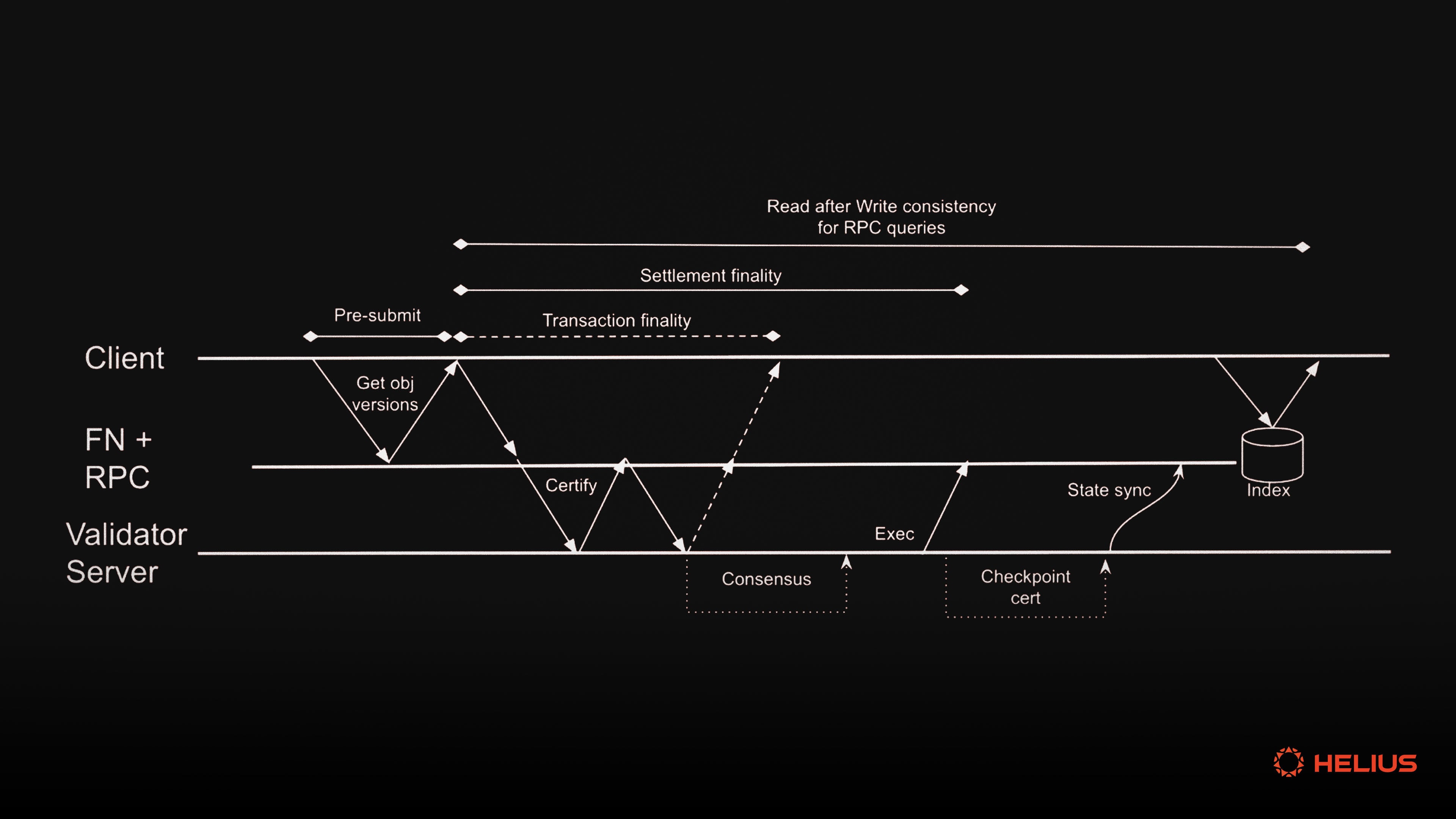
At Sui’s core is the sui move object model, an evolution of Move tailored for object-centric storage. Every asset – coins, NFTs, game items – manifests as an object with a unique address serving as its ID. Transactions target specific objects, and if disjoint, they execute in parallel via Sui’s dual-path processing: fast-path for owned objects, full consensus for shared ones.
This isn’t theoretical. Real-world DEXes on Sui process swaps atomically across user-owned pools, achieving sub-second finality. Contrast with OOP-heavy chains, where a vault contract’s update cascades locks. Sui objects promote modularity: compose apps from composable primitives, each evolvable independently.
Advisory note: When architecting dApps, audit for object contention early. Over-reliance on shared objects mimics OOP’s tight coupling, undermining gains. Instead, favor owned objects for user-specific logic, reserving shared for oracles or registries.
Core Object-Centric Design Principles for dApp Builders
Mastering object centric design principles unlocks Sui’s potential. First, prioritize owned objects for parallelism. Design user vaults as personal objects; trades become isolated transactions, scaling linearly with users. In a sui objects tutorial mindset, think “each user owns their state” – profiles, positions, even dynamic NFTs.
Second, wield shared objects judiciously. They’re potent for coordination, like AMM curves, but bloat invites bottlenecks. Minimize mutable fields; use events for off-chain indexing. Sui’s ownership types – object-owned for delegation, immutable for configs – add nuance, securing composability without trust assumptions.
Third, embrace lifecycle awareness. Objects can freeze, delete, or transfer, mirroring asset realities. This granularity outpaces OOP’s static instances, fostering resilient apps. For instance, a gaming dApp spawns player inventories as owned objects, enabling seamless P2P trades sans central server.
These tenets, drawn from Sui’s architecture, yield dApps that don’t just scale but intuit user intent. Traditional OOP developers transitioning to Sui often rediscover modularity’s joy, unencumbered by legacy chains’ chains.
Real-world applications illuminate these advantages. A DEX on Sui leverages user-owned liquidity positions as independent objects, enabling parallel swaps without global locks. This mirrors how a portfolio manager allocates assets across silos – each position evolves autonomously, optimizing returns without interference. In my experience managing multi-asset funds, Sui’s sui move object model parallels diversified holdings, where parallelism equates to compounded efficiency.
Practical Implementation: From OOP to Sui Objects
Transitioning from traditional OOP requires rethinking state as discrete entities. In a Solidity contract, a user’s balance lives in a mapping; updates serialize. Sui flips this: mint a Coin object per denomination, owned by the user. Transfers invoke object methods directly, with bytecode verifying invariants atomically.
For a sui objects tutorial, consider a simple vault. Traditional OOP: class Vault { map balances; withdraw(amount) }. Sui: struct Vault has key { id: UID, balance: Balance }. Transactions target the specific vault object, parallelizing across users. No shared mapping contention.
This shift demands discipline. Overuse of shared objects reintroduces OOP’s coupling pitfalls. Instead, design for ownership transfer: a game item object delegates via object-owned types, enabling rentals without custody loss. Scalability follows naturally, as transactions on disjoint objects bypass consensus delays.
Sui’s model departs sharply from account-based chains. Assets and states are individual objects with unique IDs, owners, and types, supporting independent updates. Two transactions on separate objects process simultaneously, conquering sequential bottlenecks. Traditional OOP encapsulates locally but falters decentralized, lacking native parallelism.
Case Study: Scalable DeFi on Sui
Examine a lending protocol. OOP-style: central pool contract manages all borrows. Peaks cause gas auctions. Sui-centric: each borrow manifests as an owned Loan object, linked via events. Repayments update only the borrower’s object, paralleling effortlessly. Lenders supply to personal Position objects, composable across protocols.
Performance metrics underscore this. Sui achieves thousands of TPS, low latency via object parallelism. Developers report 10x faster iterations versus Ethereum, as modularity accelerates testing. For Web3 innovators, this is the upgrade path: from rigid classes to fluid objects.
Yet, mastery hinges on nuanced principles. Favor owned objects for user silos – vaults, profiles – unlocking linear scaling. Reserve shared objects for lightweight coordination, like price feeds, curbing conflicts. Sui’s ownership spectrum – single-owner for privacy, shared for collaboration, immutable for standards – fortifies designs against exploits.
Integrate lifecycle management: objects freeze post-maturity, delete upon redemption, transfer seamlessly. This asset fidelity outstrips OOP’s persistence, aligning blockchain with tangible economics. Gaming dApps spawn inventories as owned collections; trades settle P2P, no intermediary drag.
Advisory perspective: As funds evolve hybrid strategies, Sui empowers tokenized portfolios. Each allocation as an object enables granular rebalancing, parallel executions mirroring market speeds. Holistic object views indeed yield superior outcomes, future-proofing against Layer 1 congestion.
By internalizing object centric design principles, builders craft intuitive dApps that scale with adoption. Sui objects transcend OOP constraints, delivering a blockchain where modularity meets velocity – the cornerstone for next-generation decentralized ecosystems.