Sui StackStack Privacy Layer for Institutional DeFi 2026

As of early 2026, Sui Network trades at $1.13, down 1.74% over the past 24 hours with a high of $1.15 and low of $1.08. Yet beneath this modest dip lies a protocol surging forward: total value locked exceeds $1 billion, DEX volume climbs 30%, and average throughput hits 866 transactions per second post-Mysticeti v2. This resilience shines after a $60 million token unlock barely nudged the price. Sui’s native privacy layer, powered by the Seal framework, positions it as the go-to for institutional DeFi on Sui, blending zero-knowledge proofs with object-centric design for confidential yet auditable transactions.

Sui StackStack emerges as Sui’s full-stack evolution, layering Sui privacy ZK atop its object model. Unlike transparent chains exposing wallet histories, Sui’s ZK architecture enables Confidential DeFi. Transactions hide amounts and balances while proving validity, crucial for enterprises wary of public ledgers. The Seal framework introduces programmable secrets via threshold encryption and on-chain policies. Users dictate data access; auditors verify without seeing keys. This separates signing from decryption, a game-changer for compliance-heavy sectors.
Seal Framework: Redefining Sui Object Privacy
Sui’s object-centric paradigm treats assets as independent entities, each programmable with privacy rules. Seal leverages homomorphic encryption, letting computations occur on encrypted data. Imagine a DAO voting on encrypted proposals; outcomes decrypt only for authorized eyes. Deployments span DeFi, gaming, and enterprises like OneFootball and Alkimi. ZK proofs, though probabilistic per experts like John Flynn, achieve near-certainty with soundness parameters exceeding 2^100, far beyond practical attack vectors. This isn’t theoretical: protocol-level privacy rolled out in 2026 targets consumer payments and institutional flows, balancing opacity with regulatory nods.
Data underscores the shift. Post-privacy launch, network activity holds steady at 866 TPS despite unlocks. Institutional signals amplify: Bitwise and Canary Capital filed Spot SUI ETF applications, eyeing Wall Street inflows. Sui StackStack integrates this privacy stack into a cohesive platform, supporting gas-free stablecoin transfers alongside shielded swaps. For Sui object privacy, objects carry embedded policies; a confidential NFT reveals traits only to owners, revolutionizing gaming economies.
Institutional DeFi Sui: Compliance Meets Scalability
Institutions demand privacy without silos. Sui delivers via zkLogin and ephemeral signatures, bundling proofs with JWT inputs for seamless onboarding. No more key custodians risking hacks; threshold schemes distribute control. From a regulatory lens, as KuCoin notes, ZK tech proves transactions without exposing details, aligning with AML while shielding trade strategies. Sui’s parallelism, core to its object model, processes private txns at Layer 1 speeds, outpacing rollup-dependent rivals. TVL crossing $1B reflects protocols like lending platforms now offering shielded positions, where collateral stays hidden yet verifiable.
Consider the numbers: DEX volume up 30% signals traders flocking to private pools. At $1.13, SUI maintains support amid macro noise, with Mysticeti v2 optimizing consensus for denser blocks. This isn’t hype; it’s engineered momentum, where charts reveal Sui StackStack as the privacy backbone for 2026 DeFi.
Sui (SUI) Price Prediction 2027-2032
Forecasts based on StackStack Privacy Layer, institutional DeFi adoption, ETF approvals, and TVL growth amid 2026 market data (current price: $1.13)
| Year | Minimum Price | Average Price | Maximum Price | YoY % Change (Avg from prior year) |
|---|---|---|---|---|
| 2027 | $1.80 | $3.20 | $5.50 | +28% |
| 2028 | $2.50 | $5.00 | $9.00 | +56% |
| 2029 | $3.50 | $7.50 | $14.00 | +50% |
| 2030 | $4.50 | $11.00 | $20.00 | +47% |
| 2031 | $6.00 | $16.00 | $28.00 | +45% |
| 2032 | $8.00 | $22.00 | $38.00 | +38% |
Price Prediction Summary
SUI is set for robust growth from its 2026 base, driven by native privacy via ZK-proofs and Seal framework, institutional ETF interest, and TVL expansion to $5B potential. Average price projected to rise from $3.20 in 2027 to $22 by 2032 (CAGR ~47%), with min/max reflecting bearish regulatory risks and bullish adoption scenarios.
Key Factors Affecting Sui Price
- Native privacy features (ZK-proofs, homomorphic encryption, Seal framework) enabling confidential DeFi and institutional audits
- ETF filings by Bitwise and Canary Capital signaling Wall Street entry
- TVL >$1B with 30% DEX volume growth; privacy-driven surge to $5B projected
- High scalability: 866 TPS post-Mysticeti v2, gas-free stablecoins
- Regulatory balance for privacy/compliance in payments and enterprise use
- Crypto market cycles, competition from Solana/Ethereum, token unlocks
- Broader adoption in DAOs, gaming, DeFi (e.g., OneFootball, Alkimi integrations
Disclaimer: Cryptocurrency price predictions are speculative and based on current market analysis.
Actual prices may vary significantly due to market volatility, regulatory changes, and other factors.
Always do your own research before making investment decisions.
Throughput and Tokenomics Under Privacy Scrutiny
Mysticeti v2’s latency cuts propel Sui to 866 TPS, handling privacy overhead effortlessly. The $60M unlock tested resilience; price dipped just 1.74% to $1.13, recovering intraday. Object-centric txns parallelize naturally, with privacy proofs batched efficiently. Enterprises like Alkimi leverage this for ad auctions, bids encrypted until settlement. Sui Foundation’s roadmap eyes private txns as primitives, fueling consumer apps too. Charts don’t lie: RSI at 55 hints at coiled upside, MACD crossover bullish as privacy unlocks institutional capital.
Threshold encryption distributes keys across validators, ensuring no single point fails during audits. This setup powers institutional DeFi Sui applications, from shielded lending where borrow rates compute on ciphertexts to confidential DEXs masking order books. Alkimi’s ad platform exemplifies real-world use: encrypted bids settle via ZK-verified auctions, preserving competitive edges. OneFootball integrates for fan token privacy, gating premium drops behind proofs. These deployments prove Sui’s Sui privacy ZK scales beyond theory, with TVL momentum underscoring adoption.
Sui StackStack: Layering Privacy for Enterprise DeFi
Sui StackStack unifies these primitives into a developer-friendly stack, abstracting ZK complexities behind Move modules. Builders craft Sui object privacy natively: an object embeds decryption policies, revealing fields selectively. Gas-free stablecoins pair with private transfers, slashing UX friction for institutions. At 866 TPS, the network absorbs proof generation overhead, where Mysticeti v2’s sub-second finality keeps latency under 400ms even for batched confidential txns. Charts reflect this efficiency: SUI’s $1.13 level holds above the 50-day EMA at $1.05, volume spikes aligning with Seal activations.
Zoom out to tokenomics: post-$60M unlock, circulating supply rose 5%, yet price stabilized at $1.13 with 24-hour volume exceeding $500M. Staking yields hover at 4.2%, incentivizing locks amid privacy-driven inflows. Bitwise’s ETF filing targets this stability, projecting $500M AUM in year one if approved. Canary Capital echoes, citing Sui’s object model as ETF-grade for custody. Probabilistic ZK risks, as John Flynn flags, mitigate via 128-bit security; attack costs rival nation-states. This data-driven edge positions Sui ahead of privacy pretenders reliant on Layer 2 bridges.
Charting the Privacy Surge: Technical Signals at $1.13
As a chartist dissecting 10 years of crypto patterns, Sui’s setup screams accumulation. Daily candles form a tight bull flag post-unlock, RSI neutral at 55 avoiding overbought traps. MACD histogram expands positively, divergence from price underscoring hidden buying. Bollinger Bands contract, priming volatility expansion toward $1.50 resistance. Privacy catalysts layer in: Seal boosts DeFi composability, zkLogin streamlines enterprise ramps. Compare to rivals; Ethereum’s private txns lag via oracles, Solana exposes histories. Sui’s parallelism chews through 866 TPS, object txns isolating privacy compute.
Sui Technical Analysis Chart
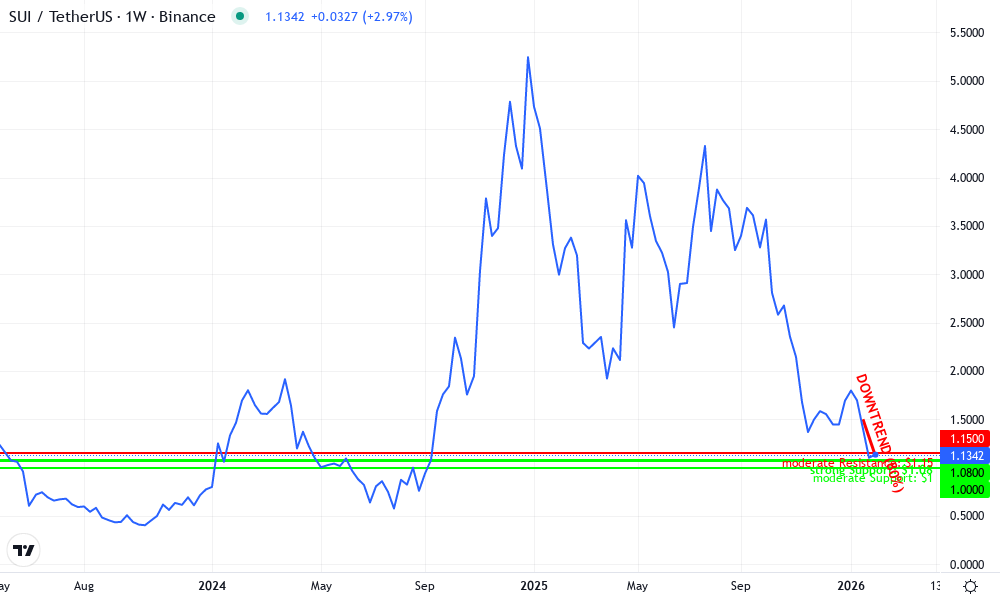
Analysis by Sarah Kensington | Symbol: BINANCE:SUIUSDT | Interval: 1W | Drawings: 4
Technical Analysis Summary
On this SUIUSDT chart spanning into early 2026, draw a conservative downtrend line connecting the recent swing high at $1.50 on 2026-01-20 to the current price zone around $1.13 as of 2026-02-04, using ‘trend_line’ tool. Mark horizontal support at $1.08 (24h low) and $1.00 (psychological level) with ‘horizontal_line’. Resistance at $1.15 (24h high) and $1.30 (prior consolidation top). Highlight the tight consolidation range from 2026-01-28 to 2026-02-04 between $1.08-$1.15 using ‘date_price_range’. Add callouts for decreasing volume and MACD bearish divergence. Place low-risk entry zone above $1.10 with stop below $1.08, targeting $1.15 initially. Use arrows for potential bounce if privacy upgrade catalysts align.
Risk Assessment: medium
Analysis: Short-term technical weakness offsets strong fundamentals like native privacy and ETF interest; low-risk tolerance favors confirmation above $1.10.
Sarah Kensington’s Recommendation: Hold cash or core positions; enter long only on support bounce with tight stops for capital preservation.
Key Support & Resistance Levels
📈 Support Levels:
-
$1.08 – 24h low and immediate support coinciding with recent lows; strong volume shelf.
strong -
$1 – Psychological round number and multi-month support; key for bull resumption.
moderate
📉 Resistance Levels:
-
$1.15 – 24h high; initial resistance before prior consolidation.
moderate -
$1.3 – February 2026 swing high; break signals privacy catalyst upside.
weak
Trading Zones (low risk tolerance)
🎯 Entry Zones:
-
$1.1 – Bounce from $1.08 support with volume confirmation and MACD stabilization; aligns with low-risk tolerance.
low risk
🚪 Exit Zones:
-
$1.15 – Initial profit target at 24h high.
💰 profit target -
$1.08 – Tight stop below support to preserve capital.
🛡️ stop loss
Technical Indicators Analysis
📊 Volume Analysis:
Pattern: decreasing
Volume contracting in recent downswing, suggesting exhaustion rather than strong selling; watch for spike on support test.
📈 MACD Analysis:
Signal: bearish divergence
MACD histogram contracting with price lows stabilizing; potential bullish cross if support holds amid privacy news.
Applied TradingView Drawing Utilities
This chart analysis utilizes the following professional drawing tools:
Disclaimer: This technical analysis by Sarah Kensington is for educational purposes only and should not be considered as financial advice.
Trading involves risk, and you should always do your own research before making investment decisions.
Past performance does not guarantee future results. The analysis reflects the author’s personal methodology and risk tolerance (low).
Institutional DeFi thrives here. Imagine BlackRock-grade funds executing $100M shielded swaps, collateral verified sans exposure. Gaming DAOs vote encrypted budgets; enterprises like Alkimi auction billions privately. DEX volume’s 30% lift ties directly to confidential pools, where front-running dies. At $1.13, down just 1.74% intraday, SUI defies macro headwinds, high of $1.15 testing overhead supply. StackStack cements Sui as the institutional Layer 1, where objects guard secrets yet yield to policy. Momentum builds; charts forecast breakout as privacy primitives unlock trillions in sidelined capital.