
What is object-centric architecture
Object-centric architecture is a design pattern where data and the logic that operates on that data are encapsulated within discrete, independent units called objects. Instead of treating data as a passive resource stored in a central database and accessed by external services, this approach treats the object as the primary unit of state and behavior.
In this model, each object owns its data and exposes methods to interact with it. This stands in contrast to traditional microservices architectures, which often rely on external APIs to fetch and manipulate data across service boundaries. It also differs from purely data-centric models, where the database schema dictates the application structure and business logic is scattered across separate layers.
By keeping data and logic together, object-centric systems reduce the need for complex data synchronization and transactional coordination across network boundaries. This makes it easier to manage state changes and ensures that objects remain consistent without requiring external orchestration.
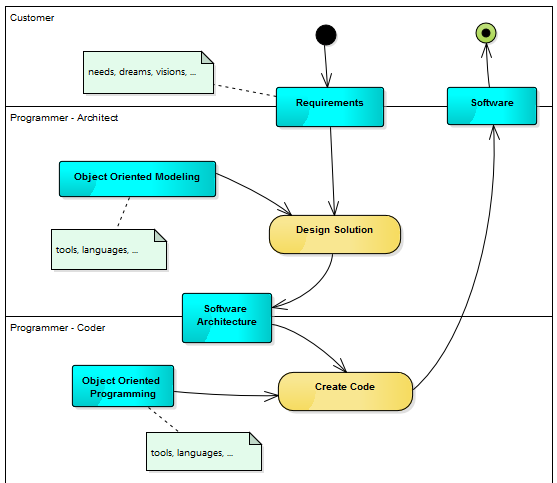
This architectural shift is particularly relevant in modern distributed systems, such as those built on blockchains like Sui, where objects serve as the fundamental building blocks for state management. In these environments, objects can be accessed, modified, or transferred independently, enabling higher throughput and more flexible composability than traditional service-oriented approaches.
How object-centric differs from microservices
Microservices split applications into independent services that communicate over a network. Object-centric architecture shifts the boundary from services to individual objects. Each object carries its own state and logic, allowing it to be managed independently without coordinating with a central service layer.
This shift changes how data flows through your system. In microservices, data ownership is often fragmented across databases, requiring complex joins or API calls to assemble a complete picture. In object-centric models, the object itself is the unit of truth. It contains all necessary attributes and behaviors, reducing the need for cross-service queries.
Side-by-side comparison
The table below highlights the structural differences between the two approaches.
| Dimension | Microservices | Object-Centric | Impact |
|---|---|---|---|
| Data Ownership | Fragmented across service databases | Encapsulated within the object | Simpler consistency models |
| Coupling | Tight coupling via synchronous APIs | Loose coupling via object references | Easier independent evolution |
| Scalability | Horizontal scaling per service | Granular scaling per object type | Higher resource efficiency |
| Complexity | High operational overhead | Lower operational overhead | Faster development cycles |
Why the shift matters
Object-centric architecture reduces the cognitive load of managing distributed transactions. Instead of coordinating multiple services to update related data, you update the object directly. This approach aligns more closely with how developers naturally think about entities and their relationships.
For example, in a microservices architecture, updating a user profile might require calling separate services for personal details, preferences, and settings. In an object-centric model, the user object holds all this information. Updating it is a single, atomic operation.
Real-world examples in 2026
Object-centric architecture has moved from theoretical research to foundational infrastructure in 2026. The shift is most visible in two distinct domains: blockchain data models and artificial intelligence systems. Both sectors rely on the same core principle: treating discrete entities as first-class citizens rather than abstract records.
Blockchain platforms
Sui represents the most prominent adoption of this model in distributed systems. Unlike traditional ledgers that track account balances, Sui treats every digital asset as an independent object with its own address and lifecycle. This approach allows for parallel processing of transactions that do not share state, significantly increasing throughput.
The object-centric data model enables fine-grained access control. Each object can define its own update rules, allowing for complex ownership hierarchies and programmable logic embedded directly in the asset. This structure reduces the computational overhead required to validate global state changes, making it suitable for high-frequency applications like gaming and real-time trading.
AI and machine learning systems
In artificial intelligence, object-centric architectures address the "multi-object problem" by disentangling individual entities within complex scenes. Research from ICLR 2024 demonstrates that these models can reduce multi-object tracking to a set of single-object disentanglement tasks. This method is more data-efficient, requiring significantly fewer perturbations to learn robust representations compared to Euclidean encoding approaches.
These systems assume that visual input is composed of distinct objects, allowing the model to reason about each entity independently. This capability is critical for autonomous navigation and robotics, where the system must predict the trajectory of individual agents rather than treating motion as a single fluid field.
Key implementations
The following examples illustrate how different industries are applying object-centric principles to solve specific scalability and reasoning challenges.
Current implementations
-
Sui Blockchain
Uses object-centric data model for parallel transaction processing and fine-grained asset ownership. -
ICLR 2024 AI Models
Leverages weak supervision from sparse perturbations to disentangle object properties in visual data. -
CVPR Computer Vision
Applies object-centric representations to improve tracking accuracy in dynamic environments.
Benefits and choices that change the plan
Adopting object-centric architecture offers a distinct advantage in data efficiency, particularly for causal representation learning. Traditional models often require massive datasets to understand complex scenes. By decomposing visual input into discrete, independent objects, these architectures reduce the multi-object problem to a series of single-object disentanglement tasks. This shift means the model requires significantly fewer perturbations to learn robust features compared to approaches that encode directly to Euclidean spaces. The result is a system that generalizes better from limited training data.
The primary tradeoff lies in implementation complexity. Building an object-centric pipeline requires careful design of the object proposal and attribute prediction modules. This adds a steeper learning curve for engineering teams accustomed to end-to-end monolithic networks. The initial development time is higher, and debugging can be more challenging due to the modular nature of the components. However, this upfront investment often pays off in long-term maintainability and interpretability.
Another consideration is computational overhead during inference. While training may be more efficient, the need to dynamically allocate and manage object slots can introduce latency. For real-time applications with strict latency constraints, this overhead must be carefully benchmarked. Despite these challenges, the benefits of structured, causal understanding often outweigh the costs for applications requiring deep scene comprehension, such as robotics and autonomous navigation.
No comments yet. Be the first to share your thoughts!