
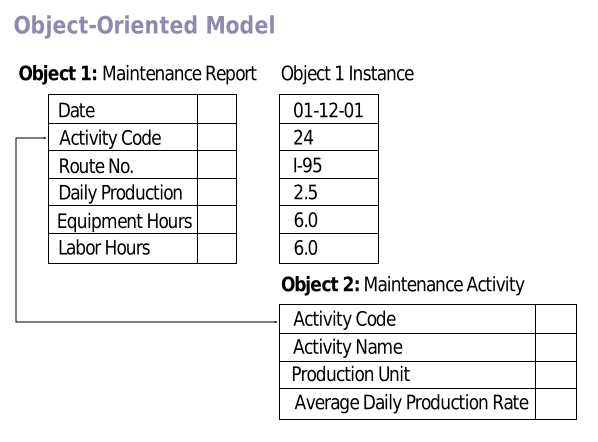
The 2026 shift to object-centric models
The dominant architecture for global-scale systems is undergoing a fundamental restructuring. For decades, relational databases and account-based ledgers served as the standard for managing digital assets. These models treated data as rows in a table or balances in an account, forcing systems to process transactions sequentially to maintain consistency. This approach created inherent bottlenecks as user bases and transaction volumes expanded, limiting throughput and increasing latency.
Object-centric architecture replaces this table-centric paradigm by treating individual data items—objects—as the primary unit of value and state. Instead of updating a global ledger, systems can validate and process these objects independently. This shift allows for parallel execution, where multiple transactions involving different objects are processed simultaneously without conflict. The result is a significant increase in system capacity and a reduction in processing time, which is essential for applications requiring real-time responsiveness at scale.
This architectural change is not merely incremental; it represents a structural advantage for networks aiming to support mass adoption. By decoupling the processing of unrelated data points, object-centric models eliminate the serialization required by traditional relational approaches. This distinction is becoming a critical differentiator in the Layer 1 blockchain space, where throughput and cost efficiency are primary metrics for developer and user adoption. The market is increasingly rewarding architectures that can handle high-frequency interactions without compromising on security or decentralization.
The transition to object-centric models reflects a broader industry recognition that scalability cannot be achieved solely through optimization of existing structures. It requires a rethinking of how data is stored, accessed, and updated. As 2026 progresses, the performance gap between object-centric and traditional relational systems is expected to widen, making the choice of underlying data model a decisive factor in the success of large-scale digital platforms.
Objects versus accounts and tables
The shift from relational tables to object-centric storage represents a fundamental change in how digital assets are owned and accessed. In traditional account-based models like the Ethereum Virtual Machine (EVM), data is grouped under a single address. This design forces the network to process transactions sequentially to prevent state collisions, creating a bottleneck as usage scales. In contrast, the object-centric architecture used by Sui treats every piece of data as an independent object with its own unique identifier and ownership rules.
This structural difference allows for parallel execution. When each object is distinct, transactions that interact with different objects can be processed simultaneously without risking data integrity. Relational databases, which rely on rigid schemas and foreign keys, struggle to replicate this flexibility. They require complex joins and locking mechanisms that slow down high-throughput operations. Object-centric models eliminate these constraints by making the object itself the primary unit of state.
The table below compares these three approaches across key dimensions of data handling and execution.
| Data Model | Ownership Structure | Execution Parallelism | Data Access Pattern |
|---|---|---|---|
| Object-Centric (Sui) | Per-object, immutable or mutable | High, based on object dependencies | Direct reference by object ID |
| Account-Based (EVM) | Shared by account address | Low, sequential state updates | Account storage slots |
| Relational (SQL) | Table rows with foreign keys | Limited, requires locking/joins | Structured queries and joins |
The implications for developers and users are significant. In an object-centric system, assets like tokens or NFTs are not just entries in a ledger; they are first-class citizens that can be moved, modified, or destroyed independently. This granularity simplifies complex interactions, such as trading or gaming mechanics, by reducing the need for centralized coordination. As the market for high-performance blockchains evolves, this architectural choice becomes a defining factor in scalability and user experience.
Parallelism and transaction throughput
Object-centric architecture fundamentally rewrites the rules of transaction processing by shifting the unit of concurrency from the account to the object. In traditional relational or account-based models, two transactions involving the same account must be sequenced to prevent state conflicts, creating a bottleneck that limits throughput. Object-centric design removes this sequential constraint. Because each object is treated as an independent entity with its own ownership and state, transactions that touch distinct objects can be executed simultaneously without interference.
This independence allows systems to process thousands of operations in parallel rather than waiting for a single linear chain to clear. The result is a dramatic increase in transaction throughput, enabling the network to handle high-frequency trading, real-time gaming, and mass-market consumer applications that would otherwise choke on latency. The architecture effectively turns a single-lane road into a multi-lane highway, where traffic flows freely as long as the vehicles are not targeting the same specific lane marker.
The implications for 2026 are significant. As demand for on-chain liquidity and real-time data verification grows, the ability to scale horizontally through parallelism becomes a competitive moat. Networks relying on legacy account structures struggle to maintain speed without sacrificing decentralization or increasing costs. Object-centric models offer a path to high performance without compromising the integrity of the underlying state, making them essential for the next generation of global-scale applications.
How Move Blocks Reentrancy Attacks
The Move programming language eliminates reentrancy attacks by enforcing strict object ownership rules. In traditional EVM architectures, smart contracts often share mutable state, allowing malicious actors to recursively call functions before a transaction completes. Move treats every asset as a unique object with a single owner. A function cannot access or modify an object unless it holds that object in its current scope. Once the function returns, the object is either transferred to a new owner or destroyed, making recursive exploitation impossible.
This architectural shift transforms security from a coding discipline into a structural guarantee. Developers no longer need to manually implement reentrancy guards or carefully order state updates. The compiler rejects any code that attempts to access an object outside its valid scope. This reduces the attack surface significantly, as the most common vector for high-stakes exploits—state manipulation during concurrent execution—is removed at the language level.
The implications for capital preservation are immediate. While legacy chains continue to suffer from multi-million dollar exploits, Sui’s object-centric model offers a fundamental defense. As noted by community analysis, this is not merely an incremental improvement but the only architectural fix for the recurring $100M+ hacks plaguing EVM-compatible networks. By moving security from the application layer to the protocol layer, Move ensures that the most dangerous vulnerabilities simply cannot compile.
When object-centric architecture fits best
Relational databases excel at structured, predictable data, but they fracture under the weight of highly dynamic, interconnected entities. Object-centric architecture replaces this rigid schema with a model where data is treated as independent, versioned objects. This shift is not merely a technical preference; it is a structural necessity for systems where data changes faster than the application logic can adapt.
The architecture outperforms legacy models in three specific high-stakes scenarios:
High-Throughput Transactional Systems
In environments like decentralized finance or real-time gaming, the overhead of locking rows to maintain relational integrity becomes a bottleneck. Object-centric models allow parallel processing of independent objects, enabling linear scalability. For protocols like Sui, this means handling thousands of transactions per second without the contention issues that plague traditional SQL databases. The market efficiency of these systems is directly tied to their ability to process state changes concurrently.
Complex, Evolving Data Models
Startups and R&D platforms often face shifting requirements. Adding a new field in a relational database requires migrations, downtime, and coordination across teams. In an object-centric model, new attributes are simply added to the object itself. This reduces the friction of innovation, allowing teams to iterate on data structures without breaking existing queries or requiring full-stack deployments.
Interconnected Asset Management
When data entities have many-to-many relationships that change frequently, maintaining referential integrity in SQL becomes computationally expensive. Object-centric architectures treat relationships as first-class citizens, allowing for efficient traversal and modification of complex graphs. This is critical for supply chain tracking, digital identity systems, and any application where the context of an object is as important as the object itself.
No comments yet. Be the first to share your thoughts!