
What object-centric architecture actually means
Object-centric architecture treats software as a collection of distinct, manipulable entities rather than a monolithic block of data. In traditional data-centric models, information often lives in flat structures or massive tables where relationships are implicit and logic is scattered. This approach forces developers to constantly reconstruct context, leading to fragile systems that break when the underlying data schema shifts.
Instead, object-centric design focuses on discrete objects that encapsulate both state and behavior. Each object represents a clear concept—like a user, a transaction, or a product—with its own boundaries. This separation allows teams to modify one part of the system without rewriting the entire codebase. It is a shift from managing data to managing interactions between independent units.
Consider the difference between a spreadsheet and a physical filing cabinet. A spreadsheet (data-centric) requires you to understand the entire grid structure to find a single record. A filing cabinet (object-centric) lets you grab a specific folder without disturbing the others. Object-centric architecture applies this logic to code, making systems easier to debug, test, and scale.
This paradigm aligns with how humans naturally think about the world. We don't see a database; we see cars, people, and events. By modeling software around these real-world entities, object-centric architecture reduces cognitive load and makes complex systems more intuitive to build and maintain.

Data-centric vs object-centric choices that change the plan
Choosing between data-centric and object-centric architectures comes down to how you handle complexity. Data-centric models treat inputs as flat vectors or grids, which works well for simple, isolated patterns. Object-centric models break scenes into distinct entities, allowing the system to reason about individual parts and their relationships. This shift changes how you manage efficiency and scalability.
Data-centric approaches are often easier to implement for basic classification tasks. They require less architectural overhead and can process data quickly when the input space is constrained. However, they struggle with compositionality. As the number of objects or variables increases, the model must learn every possible combination from scratch, leading to exponential data requirements. This makes them brittle in dynamic environments where new objects or interactions appear.
Object-centric architectures solve this by enforcing inductive biases that favor disentanglement. Instead of learning a monolithic representation, the model identifies separate slots for each entity. This approach is more data-efficient because it requires significantly fewer perturbations to learn causal relationships. By reducing the multi-object problem to a set of single-object disentanglement tasks, the system generalizes better to unseen configurations. The tradeoff is increased model complexity and the need for careful hyperparameter tuning to ensure slots do not collapse or duplicate.
Comparison of Approaches
The table below highlights the core differences in how these architectures handle common machine learning challenges.
| Feature | Data-Centric | Object-Centric |
|---|---|---|
| Compositionality | Poor; learns combinations explicitly | Strong; generalizes to new arrangements |
| Data Efficiency | Low; requires full joint distribution | High; learns single-object priors |
| Interpretability | Low; black-box feature maps | High; explicit object slots |
| Computational Overhead | Low; simple forward pass | Medium; iterative slot refinement |
| Best Use Case | Static, isolated pattern recognition | Dynamic scenes with multiple entities |
When to Choose Which
Use data-centric models when your problem is static and the input space is small. Examples include image classification of single objects or sentiment analysis of short text. The simplicity of the architecture often leads to faster development cycles and lower inference costs.
Choose object-centric architectures when your data contains multiple interacting entities. This includes video understanding, robotic manipulation, and causal reasoning tasks. The ability to isolate and manipulate individual objects allows for more robust decision-making in complex environments. While the initial setup is more involved, the long-term benefits in generalization and data efficiency usually justify the complexity.
Real-world examples of object-centric systems
Object-centric architecture moves beyond simple data collection to build structured world models. Instead of processing raw pixels or isolated database rows, these systems identify distinct entities and track their interactions. This shift allows software to reason about the environment much like human perception does, separating background noise from the actors that matter.
Visual object tracking in complex scenes
One of the most immediate applications is in computer vision, where systems must distinguish individual items in a crowded field. Traditional image recognition often struggles with overlapping objects or changing lighting. Object-centric models solve this by assigning unique identifiers to each entity, maintaining their state even when they move or interact.
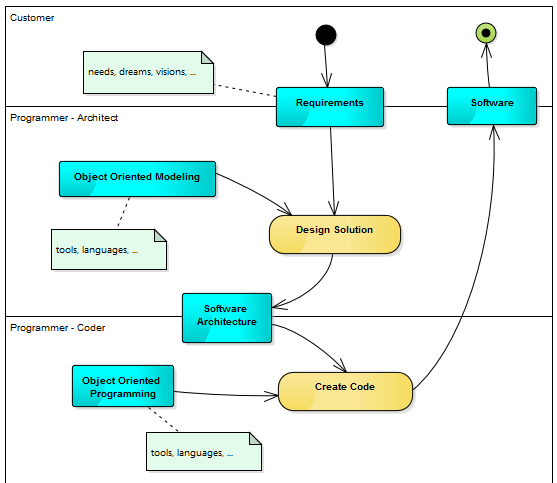
This approach is foundational for autonomous navigation and advanced robotics. By treating objects as independent variables with their own trajectories, the system can predict future states with greater accuracy. The result is a more robust understanding of dynamic environments, reducing errors in scenarios where multiple agents are present.
Structured world models for simulation
Beyond visual tracking, object-centric principles power structured world models used in simulation and planning. These architectures represent environments as collections of interacting objects rather than static grids. This representation allows for more efficient computation and better generalization across different scenarios.
When building these models, the focus is on the relationships between entities. How does one object influence another? What are the physical constraints of their interaction? By encoding these dynamics explicitly, systems can simulate outcomes without needing to retrain on every new variation of a scene. This efficiency is critical for scaling AI applications in real-world settings.
When to choose object-centric over other patterns
Object-centric architecture is not a universal upgrade. It is a specialized tool for problems where the world is made of distinct, moving parts that interact in complex ways. If your system deals with static data or simple linear processes, traditional data-centric or procedural models will likely be faster and cheaper to build.
Choose this approach when your primary challenge is understanding the relationships between entities rather than just processing their attributes. This architecture shines in scenarios requiring causal reasoning, where you need to predict how one object’s action affects another. For instance, in robotics or autonomous driving, the system must track individual objects through occlusion and predict their future trajectories independently of the background. Research indicates that these architectures can disentangle object properties using sparse perturbations, allowing the model to learn causal structures more efficiently than monolithic networks [src-serp-2].
Consider this pattern if your data has a natural hierarchical or relational structure that standard flat tables obscure. Object-centric models excel when you need to reason about composition—such as identifying parts of a whole, tracking multiple agents in a scene, or managing inventory where items have dynamic states and interactions. If your use case involves counting, tracking, or predicting behavior of discrete entities, the overhead of object extraction pays off in interpretability and accuracy.
Decision Rule: If you can solve the problem with a simple database join or a standard neural network, do not use object-centric architecture. Only adopt it when the relationships and individual identities of objects are the core complexity you need to solve.
In short, object-centric architecture is the right choice when your problem is fundamentally about things interacting, not just data points. It transforms abstract numbers into tangible entities that can be reasoned about, tracked, and predicted individually.
Future trends in object-centric modeling
Object-centric modeling is shifting from a static architectural pattern to a dynamic reasoning engine. The next evolution relies on causal representation learning, which moves beyond pattern matching to understand the underlying causes of visual data. This shift allows systems to predict how objects interact and change over time, much like human intuition.
Current research suggests that teaching AI to identify discrete objects—rather than processing pixels as a flat grid—drastically reduces the data required for accurate learning. By isolating entities, models can generalize better across different contexts. This mirrors how infants learn to recognize objects independently of their background, a concept explored in recent object-centric learning studies [src-serp-8].
As AI systems integrate these causal layers, the distinction between data-centric and object-centric approaches will blur. The focus will settle on modularity: building systems where each object is a self-contained unit of logic. This modularity ensures that changes in one part of the environment do not cascade into unrelated errors, creating more robust and interpretable artificial intelligence.
No comments yet. Be the first to share your thoughts!