
The end of the table
Traditional relational databases were built for humans who like to organize things into neat rows and columns. For decades, this worked because the tasks were predictable: track inventory, log transactions, and generate static reports. But AI agents don't think in rows. They think in actions, relationships, and causal chains. When you force an agent to query a rigid SQL schema to understand a dynamic scene, you aren't just adding latency; you are stripping away the context the agent needs to reason effectively.
Object-centric architecture treats data as a collection of distinct, interacting entities rather than a flat grid. Imagine a digital living room. In a table, the sofa, the lamp, and the window are separate rows with foreign keys linking them. In an object-centric model, the sofa is an entity with its own properties (color, position, material) and behaviors (can sit on, can be moved). This structure mirrors how we perceive reality. An agent can query "the object next to the window" without needing to join three different tables or understand the underlying schema.
The bottleneck isn't just speed; it's semantic alignment. When data is structured around objects, agents can infer causality directly. If a lamp breaks, the agent knows the light goes out because it understands the lamp as a single, causal unit, not just a row with a status: broken flag. This shift allows agents to operate in the real world with the same intuitive grasp of cause and effect that humans use every day.
How disentanglement works
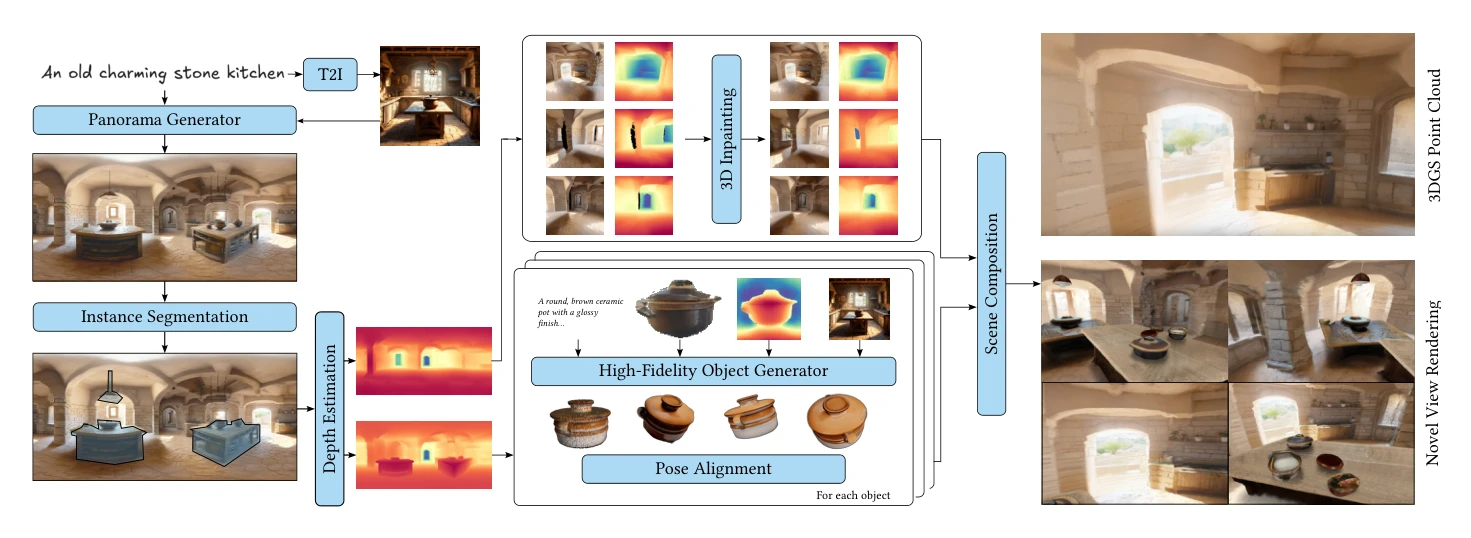
Object-centric architectures separate the visual world into distinct entities using weak supervision and sparse perturbations. Instead of trying to understand a scene as a single, dense blob of pixels, the model learns to identify individual objects and their specific properties. This approach makes data significantly more efficient for causal reasoning, allowing agents to reason about cause and effect with far fewer examples.
1. Sparse Perturbations
The system introduces small, targeted changes to the input data—such as moving one object or changing its color—while leaving the rest of the scene static. By observing how the model's internal representation shifts in response to these isolated changes, the architecture learns to attribute specific features to specific objects. This is similar to testing a single ingredient in a recipe to understand its flavor profile, rather than tasting the entire dish at once.
2. Weak Supervision
Rather than requiring manual, pixel-perfect labels for every object in every frame, the model relies on the structural consistency of the perturbations. The "weak" signal comes from the fact that the model must infer object boundaries and properties based on how they behave under change. This reduces the need for expensive, detailed annotation while still guiding the model toward a correct, disentangled representation.
3. Causal Efficiency
By isolating object properties, the architecture creates a compact, causal representation of the world. Agents can then manipulate these representations to predict outcomes or plan actions without reprocessing the entire visual input. This efficiency means that agents can learn complex behaviors from significantly fewer perturbations than comparable approaches that encode data into a Euclidean space, making the learning process both faster and more robust.
Agents Prefer Causal Links
Autonomous systems thrive on causality, not just correlation. When an AI agent encounters a busy street, it doesn't need to process every pixel of the sky or the texture of the sidewalk to make a decision. It needs to identify the car, the pedestrian, and the traffic light as distinct entities with their own trajectories. Object-centric architecture provides this clarity by disentangling the visual scene into independent objects, allowing agents to reason about each element separately.
This approach mirrors how humans plan around the world. You don't analyze the entire room as one massive data blob; you track the coffee cup, the closing door, and the walking cat as separate events. By treating objects as independent variables, agents can predict how one object will move without being confused by the static background or unrelated motion elsewhere. This reduces the computational complexity from a multi-object problem to a set of single-object disentanglement tasks, a breakthrough highlighted in recent ICLR research.
The benefits for agent behavior are tangible and immediate. Here is why this architectural shift matters for autonomous systems:
Agent Advantages in Object-Centric Models
-
Independent Reasoning
Agents can predict the trajectory of a single object without interference from background noise or unrelated moving parts, leading to more accurate decision-making in dynamic environments. -
Permutation Invariance
The system remains stable regardless of the order in which objects appear or are processed. This ensures consistent performance whether a pedestrian enters the frame from the left or right, preventing erratic behavior. -
Efficient Scaling
By focusing on individual objects, agents can scale to complex scenes with dozens of entities without a linear increase in computational cost. This efficiency is critical for real-time applications like autonomous driving or robotic manipulation.
This separation of concerns allows for more robust and adaptable AI. Instead of relearning the entire scene when a new object appears, the agent simply adds a new object to its mental model. This modularity is the foundation for next-generation autonomous systems that can handle the unpredictable nature of the real world with human-like efficiency.

Designing for permutation invariance
The final hurdle in building a truly object-centric system is teaching it to recognize items regardless of where they appear. Human perception handles this effortlessly; we know a red ball and a blue cube are the same objects whether the ball is on the left or the right. For an agent, however, a shuffled order often looks like entirely new data. If the model treats position as a primary feature, it fails to generalize.
This challenge is solved through permutation invariance, a property where the output remains constant even if the input order changes. Think of it like a grocery list: the ingredients are the same whether you write them down alphabetically or in the order you grabbed them from the fridge. In technical terms, the system uses "slot attention" mechanisms to assign specific objects to abstract slots. These slots are unordered; swapping the slot assignments doesn’t change the final understanding of the scene.
Without this invariance, agents become brittle. A robot trained to pick up a cup from the left side of a table might freeze if the cup moves to the right, because its internal representation has shifted. By enforcing permutation invariance, we ensure the agent focuses on the identity and properties of the objects themselves, not their transient coordinates. This allows the system to scale across different environments without retraining for every new spatial arrangement.
The rigidity trap in object-centric systems
Early object-centric learning models often stumble because they are built on strong architectural priors. These rigid structures assume a fixed number of objects or specific interaction patterns. While this simplifies the initial learning phase, it creates a hard ceiling for scalability. When the data complexity grows beyond these predefined boundaries, the system fails to adapt, much like a factory assembly line that breaks down when asked to handle custom, non-standard parts.
This reliance on fixed priors hinders the model's ability to generalize. In real-world scenarios, objects appear in varying quantities and contexts. A system trained to expect exactly three objects will struggle when presented with a crowded scene containing ten. The permutation invariance that is supposed to help the model ignore object order becomes a liability when the underlying architecture cannot dynamically allocate resources for new entities.
Tip: Avoid rigid priors; aim for general-purpose architectures that scale with data complexity.
To avoid this pitfall, developers should prioritize flexible, general-purpose architectures. These systems allow the number of latent objects to vary based on the input, enabling true scalability. By removing the hard constraints on object count and interaction, the model can learn to disentangle features more robustly, adapting to the messy reality of dynamic environments rather than forcing them into a static mold.
Frequently asked: what to check next
How does object-centric architecture differ from relational databases?
Relational databases store data in rigid tables where every row and column is fixed. Object-centric models treat data as independent entities, similar to how you might organize a photo album by subject rather than by date or file size. This allows agents to retrieve and manipulate specific objects without parsing entire datasets, making the system more efficient and easier to scale.
Why is permutation invariance important for AI agents?
Permutation invariance means the order of data points doesn't change the outcome. Think of a bag of marbles: it doesn't matter if you pull out the red one first or the blue one; the set remains the same. For AI agents, this ensures that the model recognizes a collection of objects consistently, regardless of how the data is shuffled or presented, leading to more robust and reliable decision-making.
Can object-centric models handle sparse or incomplete data?
Yes. Research shows that object-centric architectures can leverage weak supervision from sparse perturbations to disentangle object properties effectively. This means agents can still learn and make accurate predictions even when data is incomplete or noisy, reducing the need for massive, perfectly labeled datasets.
No comments yet. Be the first to share your thoughts!