
Defining object-centric architecture
Object-centric architecture is a design philosophy that treats distinct, identifiable entities as first-class citizens within a system. Rather than processing data as undifferentiated streams or flat structures, this approach isolates individual components to manage their properties, behaviors, and relationships independently. While the term spans both artificial intelligence and software engineering, the underlying principle remains consistent: structure complexity by focusing on discrete objects.
In the context of AI and representation learning, object-centric architectures aim to disentangle visual or sensory inputs into separate, interpretable entities. Research demonstrates that these models can leverage weak supervision from sparse perturbations to isolate each object’s properties, enabling more efficient causal reasoning and generalization. This allows neural networks to understand scenes not as pixel arrays, but as collections of interacting agents with distinct attributes.
In software engineering and data modeling, object-centric design shifts the focus from collections or accounts to the objects themselves. For instance, blockchain platforms like Sui utilize an object-centric data model where every asset is an independent entity with its own state and ownership rules. This contrasts with account-centric models, where balances are tracked as ledger entries. By treating objects as the primary unit of computation and storage, systems can achieve greater parallelism, clearer ownership semantics, and more robust state management.
The ambiguity of the term often arises from these divergent applications. However, whether dealing with disentangled latent variables in a neural network or immutable assets in a distributed ledger, the core mechanic is the same: decompose the system into autonomous objects that can be reasoned about, updated, and composed without global state interference.
Object-centric learning in AI
Object-centric learning (OCL) is a subfield of artificial intelligence focused on teaching machines to perceive the world as a collection of distinct, independent entities rather than a flat grid of pixels. Instead of processing raw sensory data as a monolithic block, these architectures aim to disentangle individual objects and their properties—such as position, velocity, and identity—from the background. This approach mirrors human cognitive development, where we instinctively recognize separate objects in a scene before analyzing their interactions.
The core mechanism relies on weak supervision through sparse perturbations. By applying minimal, targeted changes to the input data, researchers can observe how the model updates its internal representations. This method allows the system to isolate specific object properties without requiring exhaustive, pixel-level labeling for every element in a complex scene. The architecture essentially learns to group visual features into coherent, movable units that behave consistently over time.
This strategy offers significant data efficiency compared to traditional Euclidean encoding methods. Research indicates that object-centric models require significantly fewer perturbations to achieve disentangled representations, making them more scalable for complex environments. However, current methods often depend on strong architectural priors, which can hinder flexibility. As noted in recent NeurIPS discussions, moving toward general-purpose architectures remains a key challenge for broader adoption.
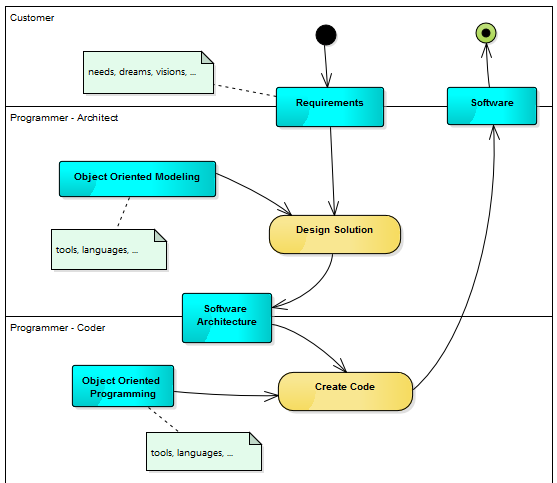
Software Design and Data Modeling
Object-centric architecture represents a fundamental shift in how software engineers structure data and logic. Unlike traditional data-centric models, which treat data as passive records stored in rigid tables, or standard object-oriented programming (OOP), which often forces data into class hierarchies that may not reflect domain reality, object-centric design centers on independent, versioned objects as the primary unit of state.
In this model, every piece of data is an object with a unique identifier, owned by a specific entity, and capable of being updated or moved without affecting unrelated parts of the system. This approach decouples data storage from business logic, allowing for greater modularity and parallel processing. As noted in industry analyses of blockchain data models like Sui, this structure enables systems to handle high-throughput transactions by treating objects as atomic units of interaction rather than rows in a shared database.
The distinction lies in the boundary of control. Data-centric architectures rely on complex joins and transactions to maintain consistency across tables, creating tight coupling. Object-centric architectures enforce loose coupling by ensuring that only the owner of an object can modify it, and modifications are tracked as distinct object versions. This reduces the need for global locks and simplifies reasoning about system state.
The following comparison highlights the architectural differences across key dimensions:
| Dimension | Data-Centric | Object-Oriented | Object-Centric |
|---|---|---|---|
| Primary Unit | Table/Row | Class Instance | Unique Object ID |
| State Management | Global Database Transactions | In-Memory Object Graphs | Versioned Object History |
| Coupling | High (Schema Dependencies) | Medium (Class Hierarchies) | Low (Independent Ownership) |
| Scalability | Limited by Join Complexity | Limited by Memory/GC | High (Parallel Processing) |
| Consistency Model | ACID Transactions | Eventual/In-Memory | Cryptographic/Versioned |
Tradeoffs and Implementation Costs
Adopting object-centric architecture introduces specific friction points that often outweigh the theoretical benefits of modular design. The primary hurdle is cognitive load: developers must manage a dual abstraction layer where entities exist simultaneously as discrete objects and as latent vector representations. This complexity demands rigorous discipline in state management, as inconsistencies between the object graph and the underlying representation can lead to subtle, hard-to-debug errors.
Serialization presents another significant challenge. Traditional object-oriented patterns rely on simple, deterministic data structures, but object-centric models often involve probabilistic latent spaces. As noted in recent research on general-purpose architectures, these methods frequently rely on strong architectural priors that can hinder scalability and complicate persistence strategies [[src-serp-5]]. Moving from a flexible, learned representation to a stable, serialized format requires custom encoding logic that breaks standard ORM conventions.
The implementation cost is not merely technical but also organizational. Teams must invest in understanding the mathematical underpinnings of the latent space, shifting focus from pure business logic to model maintenance. This shift is particularly acute in AI-driven applications, where the "object" is not a static database record but a dynamic, inferred entity. The tradeoff is clear: while object-centric patterns offer superior flexibility for complex, ambiguous domains, they demand a higher level of engineering maturity and computational overhead than traditional monolithic or service-oriented approaches.
Common questions about object-centric systems
The term "object-centric" spans distinct domains in computer science, often causing confusion between software engineering and artificial intelligence. In software engineering, particularly within blockchains like Sui, it refers to a data model where assets are first-class citizens with unique identifiers and ownership rules. In AI, specifically object-centric learning (OCRL), it describes architectures that disentangle visual inputs into independent, manipulatable representations of individual entities.
How do object-centric AI models handle state changes?
Object-centric AI models manage state by isolating properties for each identified object. Research demonstrates that these architectures leverage weak supervision from sparse perturbations to disentangle each object's properties effectively. This approach allows the system to update or interact with a single object's state without affecting the rest of the scene, significantly improving data efficiency compared to methods that encode everything into a single Euclidean vector.
Why are strong architectural priors a problem in OCRL?
While progress has been made in learning object-centric representations, many current methods rely on strong architectural priors that hinder scalability. These rigid structures limit the model's ability to generalize to complex, real-world scenarios with varying numbers of objects. General-purpose architectures aim to overcome this by learning representations that are more flexible and adaptable, reducing the need for hand-tuned constraints.
What is the primary benefit of object-centric software models?
In software design, the primary benefit is simplified concurrency and ownership management. By treating objects as independent units, systems can process updates in parallel without the complexity of shared mutable state. This aligns with the goal of building systems where data integrity is maintained through explicit ownership rules rather than global locks or complex transactional boundaries.
No comments yet. Be the first to share your thoughts!